In
bed with Lucy and Dolly
- Photograms
Mapping
the temporal balance between water and air in the form of unique bubbles—which
emerge as a result of dynamic systems that do not follow linear and hierarchal
patterns of organizational behavior—Fried charts the fundamental economy
of fluid networks in nature. In varying chromatic tones, Fried depicts strictly
non-biological membranes that evoke a strong resemblance to primordial living
cells or biotech test-tube creations, and reminds us of just how fragile,
yet adoptive the architecture of life is.
Fried
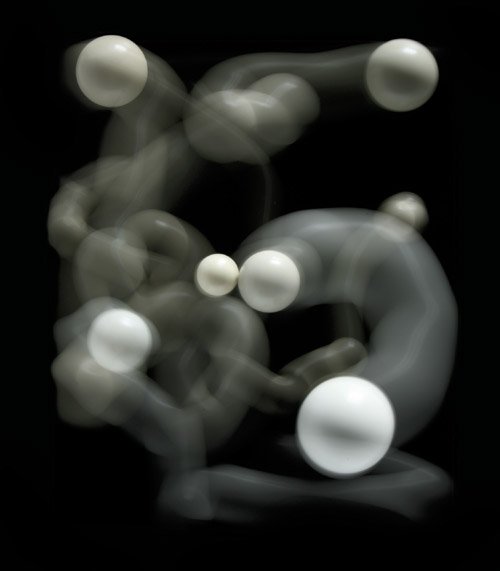
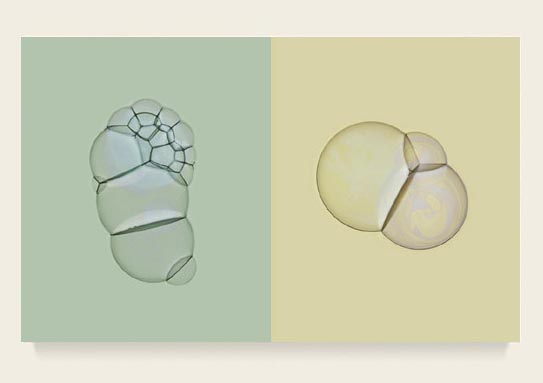
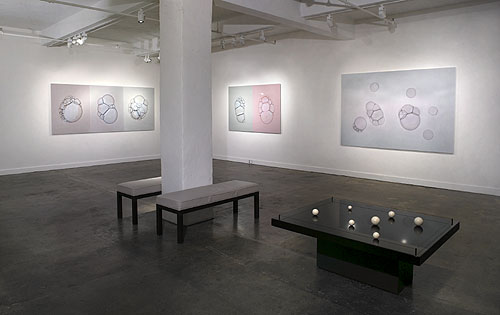
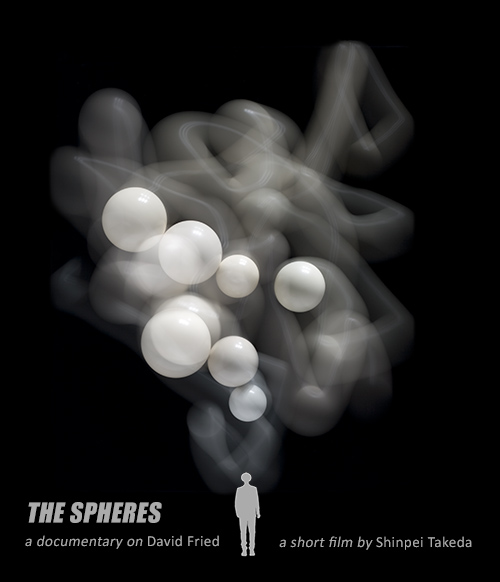
creates large gaseous vesicles in a totally darkened room using infrared
goggles. At the decisive moment before they fall, he photograms them onto
grainless color sheet-film by triggering a colored point-light source above.
He captures the shadows of these fleeting objects to make an image on a
photosensitive support using only light and the light sensitive material.
No camera or lens is used.
What
we see in his enlarged c-prints are the latent shadows and spectral aberrations
of these transparent forms caused by the membrane’s curved surface.
The object itself becomes the lens, subtly bending the light and altering
its own image.
The
series title refers to Lucy as the early hominin ‘mother’, to
Us as the ‘myth-makers’, and to Dolly the cloned sheep, as to
what Fried ironically calls the ‘missing link’, in a mythological
dialogue that seeks orientation in a world in which man has moved from adapting
to and controlling their environment, to designing life itself to fit it’s
environment. With this work, Fried involves our sense of orientation in
a world that has taken a biomorphic journey from the Cambrian sea to the
sea of science and it’s playpens of genetic engineering.
C.C.:
Would you please explain your reference in the title of the photographic
works to Dolly, the first cloned sheep?
D.F.:
With her arrival (Dolly), a media star was born. Suddenly everyone knew
a barrier was shattered between mankind’s practice of altering his
environment, and mankind‘s attempts at re-inventing himself. Humans
has always looked for what separates themselves from other species. For
me, Dolly became the missing link, fulfilling man‘s need to be supreme.
On the other hand, Lucy, an ancient hominid, is a woman of less certain
origin. Although we can clearly interpret her physiological nature, the
question is still posed: how intelligent was she really?’ Well, at
least clever enough to eat, sleep and reproduce biologically... So we find
ourselves in bed with our own past and future, trying to orientate ourselves
to this brave new world.
Christopher
Chambers is an artist, critic, and curator based in New York City.
INTERVIEW full text - English / German:
In bed
with Lucy and Dolly
- Fotogramme
In seinen
Arbeiten „Im Bett mit Lucy und Dolly“ zeigt Fried das flüchtige
Gleichgewicht zwischen Wasser und Luft in Form einzigartiger Luftblasen,
entstehend als Resultat aus dynamischen Systemen, die nicht den linearen
und hierarchischen Mustern organisierten Verhaltens folgen. Er kartografiert
so die fundamentale Ökonomie der Netzwerke in der Natur. In unterschiedlichen
Farbtönen bildet Fried ausschließlich jene nicht-biologischen
Membranen ab, die eine starke Ähnlichkeit zu den Ur-Lebenszellen oder
den Schöpfungen im biotechnischen Reagenzglas besitzen und uns daran
erinnern, wie stark und doch wie vergänglich die Architektur des Lebens
ist.
Fried
kreiert, ausgestattet mit einer Infrarotbrille, in einem vollkommen abgedunkelten
Raum große Blasen und erzeugt im entscheidenden Moment ihr Fotogramm
auf kornlosen Farbfilmbögen. Er nutzt die Schatten der - hier sogar
transparenten - Objekte, um ein Bild auf den Film zu bannen. Er verwendet
also ausschließlich Licht und lichtempfindliches Material, keine Kamera,
kein Objektiv.
Was wir in seinen vergrößerten C-Prints sehen, sind die Schatten
und die Spektralabweichungen dieser transparenten, von der gekrümmten
Oberfläche der Membran selbst verursachten Formen. Das Objekt wird
damit zum Objektiv, welches das Licht subtil bricht und damit das eigene
Bild verwandelt.
Der
Titel bezieht sich auf Lucy (die frühe Menschenmutter), auf uns (den
Mythos) und auf Dolly, das Schaf (das Missing Link). Sie stehen in einem
Dialog, der die Orientierung in einer Welt sucht, in der sich die Menschheit
von der Kontrolle ihrer Umwelt bereits wegbewegt, hin zu dem unvermeidlichen
Drang, unsere eigenen Vorfahren neu zu erschaffen.
Mit
dieser Arbeit stimuliert Fried unseren Orientierungssinn und führt
uns auf eine biomorphische Reise, vom Kambrischen Meer, bis hin den Versuchsteichen
der Wissenschaft mit ihren ersten Schöpfungen der Gentechnik.
C.C.:
Könnten Sie Ihre Anspielung im Titel der fotografischen Arbeiten zu
Dolly, dem ersten geklonten Schaft, erklären?
D.F.:
Mit dem Erscheinen Dollys war ein Medienstar geboren. Plötzlich wusste
jeder, dass eine Grenze zwischen der Praxis der Menschheit, ihre Umgebung
zu verändern, und den Versuchen der Menschheit, sich selbst neu zu
erfinden, gefallen war. Der Mensch hat immer danach gesucht, was ihn von
anderen Spezies unterscheidet. Für mich wurde Dolly zum „missing
link“ und erfüllte das Bedürfnis des Menschen nach Überlegenheit.
Andererseits ist auch Lucy, eine alte Hominide, eine Frau von mehr als zweifelhafter
Herkunft. Obwohl wir ihre physiologische Herkunft exakt bestimmen können,
stellt sich noch immer die Frage: „Wie intelligent war sie wirklich?“
Nun, zumindest klug genug, um zu essen, zu schlafen und sich biologisch
zu reproduzieren, was mehr ist als ich von unseren Vorfahren sagen kann.
Auf diese Weise finden wir uns selbst im Bett mit unserer Vergangenheit
und Zukunft wieder und versuchen uns in dieser „schönen neuen
Welt“ zurechtzufinden.
INTERVIEW
full text - English / German:
Stemmers
- Sculptures
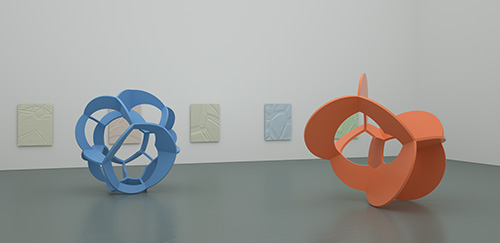
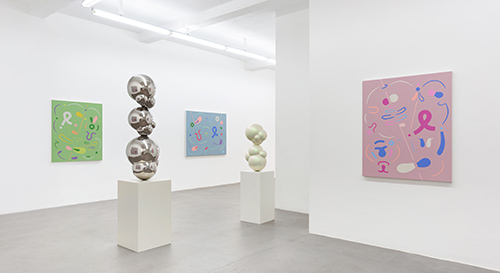
This
ongoing series of unique handmade sculptures began in 2004. Fried coined
the term “Stemmer” as a personifying name for stem cell creations.
Currently the stem cell is the most promising yet controversial programmable
self-reproducing building block on a cellular life level, which in the hands
of the genetic engineer has become the absolute malleable “bio-porcelain”
of choice at the turn of this century.
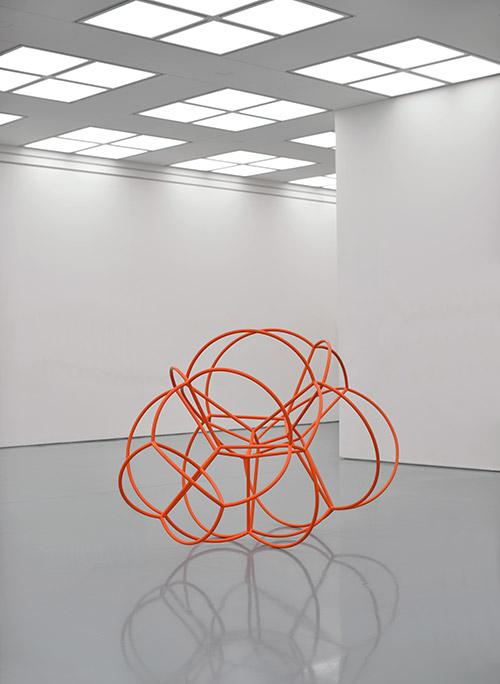
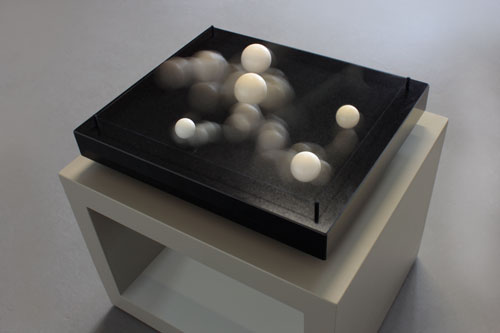
These
three-dimensional works are a series of geometrical sculptures that portray
his vision of stem cell creations with a kind of prepubescent innocence.
They look like young or undeveloped beings, easy to personify and almost
friendly in appearance. Although there is a clear association to organic
cell clusters, Fried actually follows a basic law of economy found in complex
bubbles to hand-build and facet the sculpture’s surface. The sharp-networked
angles formed by intersecting spheres of varying size result in dynamic
shapes that in spite of their clean mathematical origin appear biological,
and possess an abstract yet curiously personal character. Each Stemmer sculpture
contains several “faces” when viewed from different angles,
which easily suggest multiple abstract personalities.
If
Fried’s Stemmers are perceived as premature in vitro creations, then
one must think: what might they grow up to be? Life-savers like skin or
liver? Patented spare parts or estranged new breeds? His Stemmers also appear
to have gender, which is enforced through their intended resemblance to
figures from the stone age such as the “Venus of Willendorf”,
which depicts an anatomically exaggerated female form, or other phallic
icons found in many Paleolithic cultures.
As
in many of Fried’s other works, the artist presents us with minimalist
symbolic imagery that suggests a mix of mythological and scientific beliefs,
while calling attention to the manipulative processes that are now deeply
rooted in our cultures. By resurrecting and modernizing humankind’s
oldest fertility icons - in an era whereby applied technologies are trumping
the oldest form of reproduction and evolution - with fertility icons of
a synthetic nature for future generations, Fried confronts us with our desire
and ability to alter nature’s course, and perhaps our future evolutionary
process.
Rainscapes
- Photography
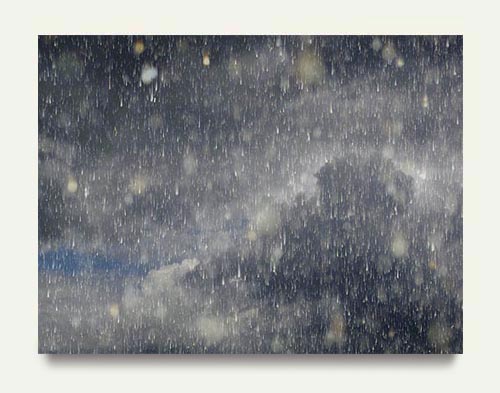
At first
glance, the colorful arrays of countless water drops in Fried’s Rainscape
photographs appear to be falling galaxies - clusters of dripping light painted
on the night sky. On closer inspection one sees that they are actually photographs
of pure falling Rain.
Fried
captures strongly individual patterns of rainfall on large format color
film. Rich chromatic variations are revealed by the prismatic effect of
light passing through each individual raindrop, evoking a spacious cosmic
look. Fried’s large-scale Rainscape photographs exude a quiet replenishing
quality that unloads poetically within the viewer.
Observing
what gives rise to civilizations, or may ultimately lead to their demise,
Fried sees freshwater as problematic in the 21st century. Since ancient
times, with prayer and ritual - to science and its methods, humans have
wished to influence the weather, and although the collective human pursuit
has undoubtedly had profound affects on the ecosystem, we are luckily still
unable to control bigger systems such as the weather. Rain still falls freely
through the world’s trees, and harvesting hands before completing
it’s cycle. However, access to - and usage of - clean water is being
moved into increasingly privatized hands, servicing industry more than local
needs and down river ecosystems. Fried’s Rainscapes portray sweet
water at its birth and invites us to contemplate its worth as we become
its temporary custodians.
Rainscapes
- Fotografie
Auf
den ersten Blick erscheinen die Reihen zahlloser bunter Wassertropfen in
Frieds “Rainscapes” (Regenlandschaften) wie stürzende Galaxien
-Ansammlungen tropfenden Lichtes vor den nächtlichen Himmel gemalt.
Erst bei näherer Betrachtung sieht man, dass es sich tatsächlich
um Fotografien reinen, fallenden Regens handelt.
Fried
bannt die höchst individuellen Muster des Niederschlags auf großformatige
Film. Durch den prismatischen Effekt, wenn Licht den einzelnen Regentropfen
passiert, entstehen reiche chromatische Variationen und erzeugen einen räumlichen,
kosmischen Eindruck. Frieds “Rainscape” – große
Fotografien strömen für den Betrachter eine stille, poetische
Anmut aus.
Mit
dem Blick darauf, was zum Aufstieg von Zivilisationen oder zu ihrem schlussendlichen
Niedergang führen mag, sieht Fried Trinkwasser als das Problem des
21. Jahrhunderts. Seit alters her haben Menschen den Wunsch gehegt, das
Wetter beeinflussen zu können, durch Gebete und Rituale bis hin zur
heutigen Wissenschaft mit ihren Methoden. Und obgleich dieses gemeinsame
menschliche Streben zweifellos einen tief greifenden Einfluss auf das Ökosystem
hatte, sind wir glücklicherweise immer noch unfähig, größere
Systeme wie das Wetter zu steuern. Wasser fällt immer noch frei durch
die Bäume dieser Erde und durch die Hände des Landmannes, bevor
es seinen Zyklus vollendet. Dennoch liegt die Herrschaft über den Zugang
und die Nutzung von frischem Wasser zunehmend bei der privaten Wirtschaft,
die der Industrie mehr dient als den lokalen Bedürfnissen und den Ökosystemen
flussabwärts. Frieds “Rainscapes” zeigen frisches Wasser
bei seinem Entstehen und laden uns ein, über seinen Wert nachzudenken
und so für kurze Zeit zu seinem Hüter zu werden.
Globalexandria
- stainless steel sculptures
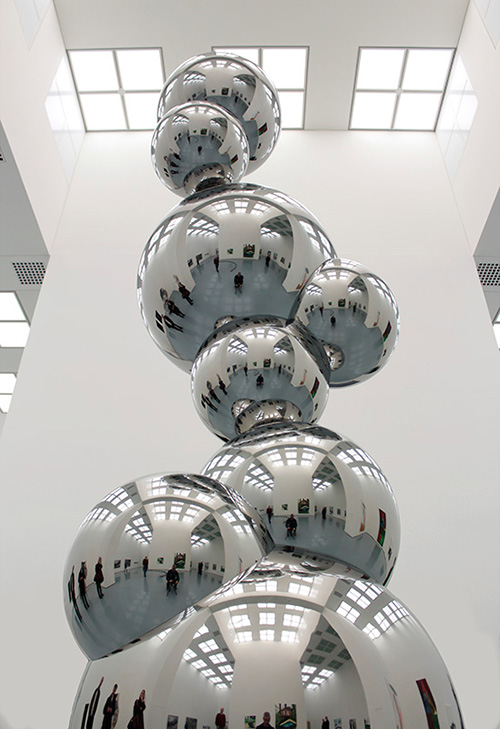
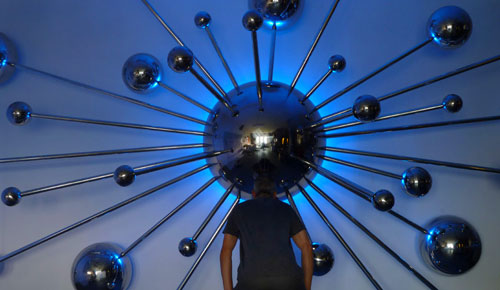
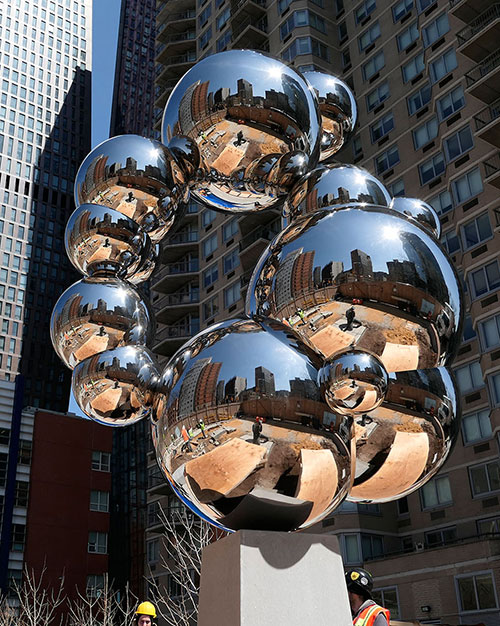
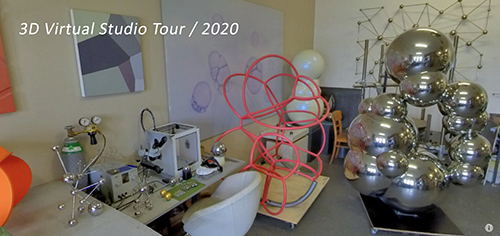
Three-dimensional
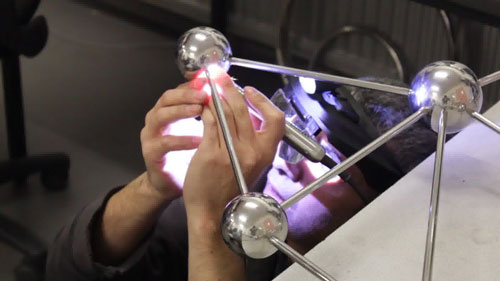
constructions of mirror-polished stainless steel spheres and intersecting
rods colonize a wall in a loosely organized manner, or grow from the floor
into free-standing networked structures—swarms of mirrored orbs that
physically support and reflect one another’s position in synoptic
play.
Fried’s
spatial ‘Globalexandria’ objects derive their essential skeletal
forms from the systems thinking information age in a gestural way. One immediately
gets a sense of motion as we look to connect the dots, perhaps in search
of some nonsensical sense, while noticing that as we project our own synaptic
perspective into the network. We can see our position reflected in all the
spheres simultaneously, and in each sphere we also find an endless rerflective
feedback of all their positions.
These
sculptures are inspired by the information age, connectivity on a global
scale, the creation of highly relevant positions through networks, and how
such internalized systemic approaches change our perceptual habits, and
by daily use, even our core beliefs. Fried reflects on the phenomenality
of these dissipative networked structures, which thrive on input, emergent
complexity and feedback.
The
title is a hybrid of Global and Alexandria. Since the fall of the ancient
Egyptian library by localized fires, our entire information age has evolved
into a decentralized structure—though just as vunerable via corruption
of data or systemic failures—that has significantly democratized knowledge
and liberated communication largely regardless of geography or class. Our
way of thinking is changing as well. Certain tools throughout the ages have
fundementally altered our approach to problem solving and eventually seeps
into our philosophies.
From
cave paintings to cuneiform to binary code, our languages also evolve with
our tools. And while literacy in code is becoming more widespread, conversely,
encryted data becomes more complex and exclusive. Oddly, we are the first
civilization to purposely design a language that no human—even geeks—can
decifer with their own senses.
Navigating
such rapid technological advancements—where the only constant is constant
change—we can get stuck using old ingrained maps and rules. We don‘t
have thousands of years to master these innovations like a hand axe. Fried
questions if our common-sense philosophies and perspectives can develop
as keenly as our technologies to narrow a wisdom-gap in the making. Like
art lives from breaking borders, even in the face of big-data, we have never
had a more empowering tool to explore and share our freedom of expression,
innovation and visions.
<<
main menu / TOP
@davidfriedartist SCROLL DOWN © david fried 2017