Press
releases / scroll down (incomplete - see cv
for more)
2017
2013
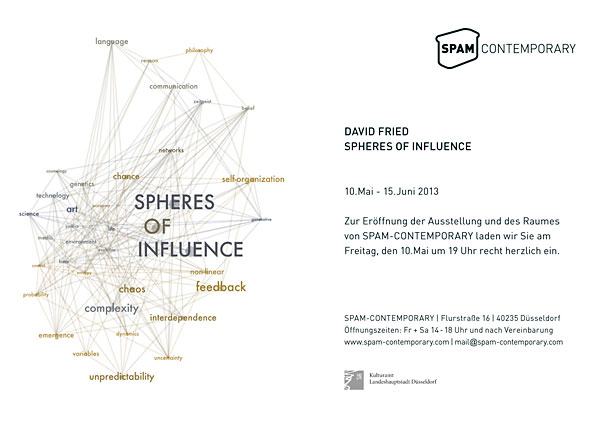
DAVID FRIED - Spheres of Influence / Eröffnung 10.5.2013
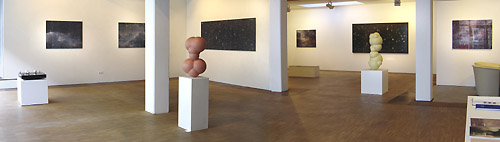
Der 1962 in New York City geborene David Fried abstrahiert in seinen minimalistischen Bildern und Objekten unsichtbare, komplexe und dynamische Beziehungen. Die darin innewohnenden Qualitäten und flexiblen Eigenschaften von interdependenten, vernetzten Systemen, die sowohl in der Natur als auch in sozialen Systemen gefunden werden, bestimmen seine skulpturalen, fotografischen und interaktiven Arbeiten. David Fried bedient sich symbolisch aufgeladener Motive, die universell als organische oder natürliche Phänomene erkennbar sind. Zudem enthalten sie gleichsam subtile Hinweise des menschlichen Einflusses, insbesondere unseren Drang zur Kontrolle, zur Manipulation und unserem Wunsch zur absichernden Prognose.
In einer menschlichlichen Welt, die zunehmend unter den Einfluss sich selbst organisierender Systeme gerät, thematisiert Fried den Raum zwischen dem Anachronismus des Newtonschen Weltbildes und dem neuen, progressiven Systemdenken. Und weit mehr als das: Frieds Arbeiten, insbesondere seine kinetischen Skulpturen, machen diese Systeme erlebbar und verdeutlichen auf beeindruckende poetische Weise, dass sie, wenngleich manipulierbar, so doch nie wirklich zu kontrollieren sind.
Frieds Werke wurden in internationalen Einzelausstellungen von New York bis Sydney präsentiert. Seine Arbeiten sind Bestandteil der ständigen Sammlungen des Kunst Museums Gelsenkirchen, des Kunst Museums Ritter, Waldenbuch, und der Volksbank HQ, Mönchengladbach. Darüber hinaus waren seine Werke neben jenen von Rebecca Horn, Robert Rauschenberg und Alexander Calder in der Wanderausstellung "Drehen, Kreisen, rotieren" zu sehen. In der Ausstellung "Genesis-Die Kunst der Schöpfung" im Zentrum Paul Klee, Bern, sind seine Arbeiten neben Duchamp, Beuys, Gormley, Nauman und anderen gezeigt worden. Hans Magnus Enzensberger hat in seinem Buch mit dem Titel:"Why Count On Chance" die Arbeiten von David Fried ebenfalls thematisiert.
David Fried lebt und arbeitet in Düsseldorf und New York. Der Kunstler ist anwesend.
http://www.zpk.org/ww/en/pub/web_root/pro/wechselausstellungen/genesis_theartofcreation.cfm
English: Scroll down for Deutsch
Synopsis
Exhibition „Genesis – The Art of Creation“
Zentrum Paul Klee, Bern, January 26, – April 27, 2008
The term 'genesis' and the theme of creation are central to Paul Klee's thinking and oeuvre. The artist saw himself as a creator directing the genesis of his works. In his writings Paul Klee also expressed himself on the relationship between science and the fine arts. His method may furthermore be compared to that of a scientist: having explored natural or geometric structures in detail, he followed specific rules in the transfer to his medium, i.e. drawing or painting.
Our project is based on a concept designed in cooperation with the Centraal Museum in Utrecht, The Netherlands, expanded for the Zentrum Paul Klee. Based on the pieces presented at the Centraal Museum, the Berne show will provide a new perspective, focusing on methodological kinships between the avant-gardes in art and in genetic research. Similar evolutionary lines can be traced in both fields: at the beginning stands a break with obsolete orthodoxies; ‘Homo novus’ studies and analyses the world with new eyes. This research produces new theories, which tend to become dogmas. However, as life is too complex both in terms of scientific codes and the '-isms' of art, these new dogmas are questioned in their turn. Artists and scientists therefore seek ways in which they can relax their systems to confront chaos anew and finding novel approaches to dealing with the complexity of the human condition.
Exhibition
Guided by innovative methodology, the visitor can explore the evolution of
genetic research and the ways in which artists have tried to come to terms
with modern genetics. On show are works of art and scientific objects that
are the result of similar work processes.
The exhibition emphasizes parallel developments and interactions in artistic
and scientific methodologies. The focus of attention is on the creative, productive
process at work in both genres.
Genesis, Analysis, Code, Playing Games and Chaos – these are the five dramatic focal points of this exhibition. They connect and combine scientific and artistic aspects of genetics and creation in a dramatically designed presentation of paintings, interactive installations, light installations, video projections, cartoons, photographs and sculptures by international artists such as Mona Hatoum, Ross Bleckner, Mark Francis, Chuck Close, Piet Mondrian, Paul Klee, Dieter Roth and Mark Dion. These heterogeneous exhibits will convey the most significant research results of the 20th and 21st centuries, placing them in an artistic context that confirms this issue's relevance to society, its wide emotional spectrum and its decade-long, unchanging political importance.
The exhibition will consist of the following five thematic sections:
1.
Genesis: creation before the discovery of the gene
Illustrations from the Bible and books of medical history that reach back
to antiquity will highlight differences in representing the creation of man.
However, the term of 'genesis' relates not only to the creation of man. In
art it also refers to the creation of forms. Concepts by Paul Klee, Joseph
Beuys and Rudolf Steiner will provide striking examples of this aspect.
Mona Hatoum's video installation, Corps étranger, will provide the
transition to the next section: using an endoscopic camera, she explores the
surface and the interior labyrinth of her own body.
2. Analysis: definition of the smallest living unit – the cell
Scientific curiosity has long driven the search for explanations of how the
human body works. To understand this, its interior had to be analysed. In
the early 19th century the cell was discovered to be the smallest living unit
in the human body and in plants.
We place scientific representations of cell structures next to works by, for
example, Ross Bleckner, Mark Francis and Jasper Johns to evoke associations
and reveal aesthetic parallels in art and science. Notes and drawings by Paul
Klee refer to similar methodologies in the analysis of units.
3.
Code: discovering and cracking the genetic code
In 1953 Francis Crick and James Watson discovered DNA's double-helix structure.
Scientific representations of DNA have inspired works of art by Dennis Ashbaugh
and Jaq Chartier – their iconographic common ground is evident.
The 'central dogma of genetics' formulated by Francis Crick in 1957, i.e.
that DNA produces RNA, which produces proteins – in other words, living
organisms consist of genes that define their characteristics – has raised
new questions concerning individual identity: 'If the code is cracked, can
I be copied?'
Portraits by Chuck Close and DNA portraits by Marc Quinn, Gary Schneider,
Thomas Kovachevich, Larry Miller and others will address this issue.
The discovery of the genetic code would have been unthinkable without the
prior transformation of information into computer code. Art from various periods
and in various media – works by Piet Mondrian, Dieter Roth's stamp alphabet,
Mundunculum, and Eduardo Kac's installation, Genesis, among others –
will demonstrate code's crucial relevance to art.
4.
Playing games: developing new forms based on analysed code
Genetic manipulation owes itself to the development of cloning techniques.
Science fiction 'documentaries' by Karl Sims and Floris Kaayk satirise these
new possibilities and show that biotechnology raises both hopes and fears.
The traditional motif of the chimera has seen a renaissance. In the past,
chimeras stood for the freakishness of nature in the course of evolution,
testifying to the triumph of nature over man. Paradoxically, today's versions
express the opposite, namely the triumph of man over nature. They also represent
visions of the New Man.
Representations of chimeras from various periods underscore art's and science’s
lasting fascination with this topic.
5.
Chaos: subverting the dogma
Reality has proven to be more complex than Life Sciences' central dogma. To
explore and understand life and its processes, scientists have returned to
the study of networks. Tremor, an installation by Kathleen Rogers, will focus
on experiments with zebra fish. Interestingly, cells are once again the objects
of manipulation.
Mark Dion's perfect imitation or 'clone' of a biotechnology laboratory for
our exhibition not only refers to the locus operandi of these interventions,
it also symbolises the chaos that still exists.
Fabienne Eggelhöfer, Exhibition curator
May 5th, 2007
Artists participating in the exhibition :
Jean Arp
Aziz & Cucher
Joseph Beuys
Max Bill
Ross Bleckner
Christine Borland
Jaq Chartier
Douglass Crockwell
Leonardo da Vinci (Faksimiles)
Agnes Denes
Mark Dion
Charles & Ray Eames
Mark Francis
Herbert W. Franke
David Fried
Fritz Glarner
Antony Gormley
Thomas Grünfeld
Mona Hatoum
Georg Herold
Floris Kaayk
Eduardo Kac
Wassily Kandinsky
Paul Klee
Thomas Kovachevich
Sol LeWitt
Aaron Marcus
Larry Miller
Vera Molnar
Piet Mondrian
Frieder Nake
Bruce Nauman
Georg Nees
Michel Paysant
Marc Quinn
Kathleen Rogers
Dieter Roth
Christa Sommerer & Laurent Mignonneau
Tomas Schmit
Lillian Schwartz
Karl Sims
Rudolf Steiner
Koen Vanmechelen
Woody & Steina Vasulka
Catalogue Available.
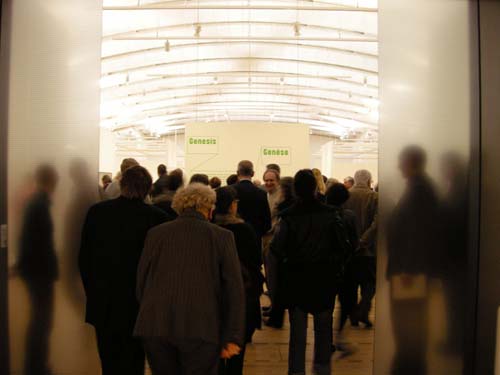
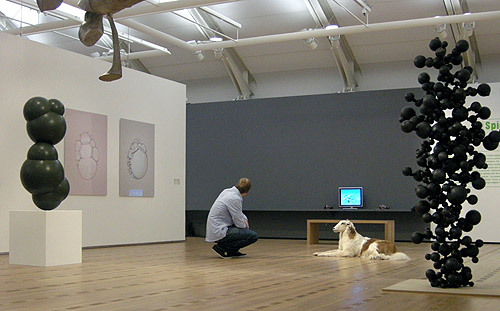 Genesis
- The Art of Creation, ZPK Bern 2008, View: David Fried, Bruce Nauman, Antony
Gormley.
Genesis
- The Art of Creation, ZPK Bern 2008, View: David Fried, Bruce Nauman, Antony
Gormley.
>DEUTSCH
Exposé
Ausstellung „Genesis – Die Kunst der Schöpfung“
Zentrum Paul Klee in Bern, vom 3. November 2007 bis 17. Februar 2008
Der Begriff „Genesis“
und das Schöpfungsthema sind im Denken und Schaffen von Paul Klee zentral.
Der Künstler sah sich selber als Schöpfer und die Entstehung der
Werke als Genese.
In seinen Schriften hat sich Paul Klee auch zum Verhältnis zwischen bildender
Kunst und Wissenschaft geäussert. Zudem ist seine Arbeitsweise vergleichbar
mit dem eines Wissenschaftlers; nach der minutiösen Untersuchung von
natürlichen oder geometrischen Strukturen übertrug er diese nach
bestimmten Regeln in sein Medium (Zeichnung oder Malerei).
Das Ausstellungsprojekt wurde gemeinsam mit dem Centraal Museum in Utrecht, Niederlande, konzipiert und für das Zentrum Paul Klee erweitert. Ausgehend von den Exponaten der Ausstellung des Centraal Museum wird in Bern eine neue Perspektive geschaffen: die methodischen Gemeinsamkeiten zwischen den Avantgarden der Kunst und der Genforschung. Beide Felder weisen ähnliche Entwicklungslinien auf: Am Anfang steht der Ausbruch aus den überholten Mustern der Orthodoxie; der Homo novus betrachtet die Welt frisch und analysiert sie neu. Aus dieser Recherche ergeben sich neue Theorien, die dazu tendieren in Dogmen zu erstarren. Da das Leben aber sowohl für die Codes der Wissenschaft als auch für die Ismen der Kunst zu komplex ist, kommen diese neuen Dogmen ins Wanken. Künstler wie Forscher suchen nach Möglichkeiten, ihr System wieder zu öffnen, sich dem Chaos neu zu stellen und sich der Komplexität der Condition humaine mit neuen Ansätzen anzunähern.
Die Ausstellung
Dem Besucher wird auf innovative Weise die Entwicklung der modernen Lebenswissenschaften
vermittelt; gleichzeitig wird die künstlerische Auseinandersetzung mit
der modernen Genetik präsentiert: Ausgestellt werden Kunstwerke und wissenschaftliche
Objekte, die Resultate ähnlicher Arbeitsprozesse sind.
Parallelität und Interaktion in den künstlerischen und wissenschaftlichen
Arbeitsmethoden werden hervorgehoben; der Schöpfungsprozess, der zu einem
Resultat führt und beiden Genres eigen ist, steht im Mittelpunkt.
„Genesis“, „Analyse“, „Code“, „Spielerei“
und „Chaos“ bilden die fünf thematischen Schwerpunkte für
die Dramaturgie der Ausstellung und verbinden sowohl die wissenschaftliche
als auch die künstlerische Seite der Genetik und der Schöpfung zu
einer inszenierten Einheit.
Die Exponate – Gemälde, interaktive Installationen, Lichtinstallationen,
Videoprojektionen, Trickfilme, Fotografien und Skulpturen international bekannter
Künstler wie Mona Hatoum, Ross Bleckner, Mark Francis, Chuck Close, Piet
Mondrian, Paul Klee, Marcel Duchamp, Dieter Roth oder Mark Dion – vermitteln
in und mit ihrer Vielfalt die wichtigsten Forschungsergebnisse des 20. und
21. Jahrhunderts und setzen sie in einen künstlerischen Kontext, der
Zeugnis ablegt über die gesellschaftliche Relevanz, die emotionale Bandbreite
und die über Jahrzehnte gleich bleibende politische Aktualität der
Thematik.
Die Ausstellung ist in folgende fünf Themenfelder gegliedert.
1. Genesis: Die
Schöpfung vor dem Zeitalter der Biowissenschaften
Mit biblischen und medizin-historischen Illustrationen wird auf die unterschiedlichen
Darstellungen der Schöpfung des Menschen seit der Antike hingewiesen.
Der Begriff „Genesis“ steht aber nicht nur im Zusammenhang mit
der Schöpfung des Menschen, sondern bezeichnet in der Kunst auch die
von Formen. Mit Konzepten von Paul Klee, Joseph Beuys und Rudolf Steiner wird
dieser Aspekt exemplarisch erläutert.
Mona Hatoums Installation Corps étranger führt in das nächste
Kapitel über: Mit einer endoskopischen Kamera untersucht sie die Oberfläche
ihres Körpers und dringt anschliessend in das innere Labyrinth des Körpers.
2. Analyse: Definition
der kleinsten lebenden Einheit – die Zelle
Die Neugier war und ist treibende Kraft für den Akt des Analysierens.
Der Forscher suchte nach Erklärungen wie der Mensch geschaffen ist. Dafür
musste er das Innere des Menschen analysieren. Anfang des 19. Jahrhunderts
wurde die kleinste lebende Einheit im Menschen und in den Pflanzen –
die Zelle – definiert. Assoziative Gegenüberstellungen von wissenschaftlichen
Zellstruktur-Darstellungen und Werken von Ross Bleckner, Mark Francis oder
Jasper Johns verweisen auf ästhetische Parallelen in Kunst und Wissenschaft.
Gleichzeitig verweisen Notizen und Zeichnungen von Paul Klee wie auch Marcel
Duchamps Analyse eines Meters in Trois Stoppages étalon auf die methodische
Gemeinsamkeit des Analysierens einer Einheit.
3. Code: Die Entdeckung
und Entschlüsselung des genetischen Codes
1953 erklärten Francis Crick und James Watson die DNA als Doppelhelix-Struktur.
Unterschiedliche Darstellungen der DNA in Wissenschaft und deren Integration
in Kunstwerken von Dennis Ashbaugh oder Jaq Chartier weisen auf ikonografische
Gemeinsamkeiten. 1957 formulierte Francis Crick das „zentrale Dogma“
der Genetik: „DNA macht RNA macht Protein“ – mit anderen
Worten: Die Gene schaffen Lebewesen und bestimmen deren Eigenschaften. Dies
warf neue Fragen zur Identität des Individuums auf wie „Wenn der
Code entschlüsselt ist, bin ich dann „kopierbar“? Mit Porträts
von Chuck Close, den DNA-Porträts von Marc Quinn, Gary Schneider, Thomas
Kovachevich oder Larry Miller wird diese Frage thematisiert.
Die Entdeckung des genetischen Codes wäre ohne die vorhergehende Entwicklung
der Codierung von Informationen im Computer undenkbar.
Kunstwerke aus unterschiedlichsten Epochen und in verschiedensten Medien zeigen
wie zentral die Codierung auch in der Kunst ist: Werke von Piet Mondrian,
Dieter Roths Stempelalphabet Mundunculum, oder auch Eduardo Kacs Installation
Genesis.
4. Spielerei:
Die Entwicklung neuer Formen aufgrund des analysierten Codes
Die Entwicklung der Klonierungstechniken ermöglichte die Genmanipulation.
Science Fiction Dokumentarfilme von Karl Sims und Floris Kaayk thematisieren
auf ironische Weise die neuen Möglichkeiten der Gentechnologie, die gleichzeitig
Hoffnungen aber auch Angst schürt.
Das tradierte Motiv der Chimären erlebt eine Renaissance. Widerspiegelten
Chimärendarstellungen bisher unberechenbare Kräfte der Natur im
Laufe der Evolution und waren somit Zeugen des Sieges der Natur über
den Menschen, so thematisieren sie heute paradoxerweise das Gegenteil, nämlich
den Sieg des Menschen über die Natur. Zudem stehen sie für Zukunftsvisionen
vom neuen Menschen.
Chimärendarstellungen aus verschiedensten Epochen weisen auf die permanente
Aktualität des Themas in Kunst und in Wissenschaft.
5. Chaos: Das
Dogma wird aufgeweicht.
Die Realität erweist sich komplexer als das zentrale Dogma der Life Sciences.
Um das Leben zu ergründen und Lebensprozesse zu verstehen, versuchen
die Wissenschaftler deshalb erneut Netzwerke zu betrachten. Kathleen Rogers
inszeniert in ihrer Installation Tremor Experimente, die an Zebrafischen vorgenommen
worden sind. Interessant ist, dass erneut in den Zellen manipuliert wird.
Das naturgetreu imitierte Labor eines Biotechnologen, welches Mark Dion für
die Ausstellung geklont hat, weist nicht nur auf den locus operandi der Forscher,
sondern verweist sinnbildlich auf das „Chaos“, das sich trotz
der Entschlüsselung des Gens manifestiert.
Fabienne Eggelhöfer,
Ausstellungskuratorin
5. Mai 2007
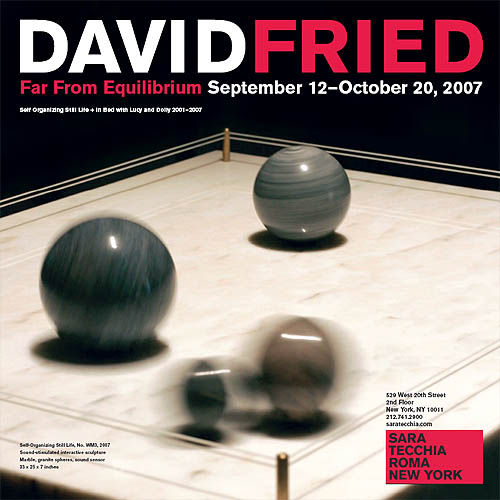
FOR IMMEDIATE RELEASE: EXHIBITION:
DAVID
FRIED
Far From Equilibrium
or, how I learned to stop worrying and love the chaos
DATES:
September 12 — October 20, 2007 (
EXTENDED TO: October 27 )
RECEPTION:
Wednesday, September 12, 6 – 8pm
Sara Tecchia Roma New York is proud to present FAR FROM EQUILIBRIUM, a solo
exhibition that marks the New York debut of Germany-based, New York-born
artist David Fried.
In our everyday life, the word “equilibrium” evokes a sense of functioning harmony or balance – a cool shower tempering a hot summer day, for instance. Only a state that is far from equilibrium, however, fosters the self-reflection and reassessment necessary for creative growth, development and life as we know or guess it.
Such dynamic relationships operating “far from equilibrium” are the common ground for Fried’s art. Weaned on Abstract Expressionism and improvisational music, his inspiration is found in all that is unpredictable. His exploration into the inherent qualities of networked systems intrinsic to nature and social endeavors are merged into highly symbolic works, which deconstruct simplistic views of a mechanical universe into interdependent systems more relevant to contemporary society.
His sculptural, photographic, and interactive works employ motifs that are universally recognizable as organic or pertaining to natural phenomena, yet appear influenced by man. He successfully fuses minimalism and conceptual art with aesthetics and philosophy to create works that transcend art-isms and scientific dogmas of our socio-technological times.
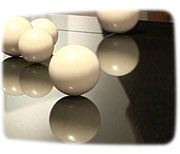
His hand-crafted “SELF ORGANIZING STILL LIFE” objects consist of interactive, sound-activated spheres, which “dance” in real-time in response to ambient sound, visualizing the live acoustics in a spontaneous and elegantly fluid choreography before one’s eyes. When sound is no longer detected, the spheres come to rest, playing still-life.
No two spheres are alike – each is composed of either solid stone or synthetic polymers layered with organic materials such as marble dust and rare earth. This infuses them with a unique ability to store energy and interact with each other in inimitable and unexpected ways, on an elemental level rather than a technological one. Fried is therefore able to give each sphere an individual personality, allowing them to respond differently to sound, as people would dance differently to the same tune. More fascinating than the motions of any one sphere are the dynamic relationships that unfold between them all.
With his series of color photograms titled “IN BED WITH LUCY AND DOLLY,” Fried uses photo-sensitive film and flashes of light to capture the shadows of fleeting bubble formations – no camera or lens is used. What we see in his enlarged chromogenic prints are the latent shadows and spectral aberrations of these transparent forms. In varying chromatic tones, Fried depicts these studies of shadow and light in a manner that evokes a strong resemblance to primordial living cells as well as engineered test-tube creations.
The title refers to Lucy (the early hominid “Mother”), to us (the “Myth-makers”), and to Dolly the sheep (the first successful cloning of a live animal, or the man-made “Missing Link”), highlighting man’s progression from merely controlling our existing environment, to engineering life-forms, to indulging in the inescapable urge to invent our predecessors. Fried reminds us of just how strong yet corruptible the architecture of life is, while taking us on a biomorphic journey from the Cambrian sea to the technological womb.
Fried’s work can be found in the permanent collections of Volksbank HQ, Mönchengladbach, Germany; Kunst Museum Ritter, Waldenbuch, Germany; and the Stadt Museum Gelsenkirchen, Germany. Additionally, he has been shown alongside that of Horn, Rauschenberg and Calder in the traveling exhibition. "Drehen, Kreisen, Rotieren” and he was also recently included “Genesis—The Art of Creation,” alongside Duchamp, Beuys, Francis and others at the Zentrum Paul Klee.
SARA TECCHIA ROMA NEW YORK is located at 529 West 20th Street, between Tenth Avenue and Eleventh Avenue. The gallery is on the second floor. Summer hours are Monday through Friday, 11am to 6pm or by appointment. For more information, contact 212-741-2900, or visit www.saratecchia.com
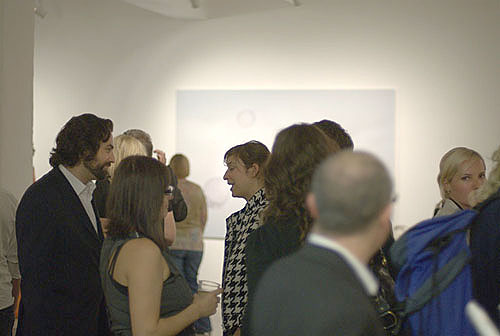
VIDEO REVIEW / Exhibition at Sara Tecchia, Chealsea NYC
 PLAY
PLAY
THE SAATCHI GALLERY / review of solo show at Sara Tecchia New York
http://www.saatchi-gallery.co.uk/blogon/2007/10/trent_morse_on_david_fried_at_1.php
2007
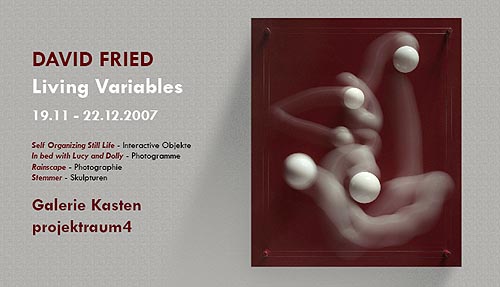
Opening: 19. November - Galerie Kasten, Projektraum4, Manheim, Germany.
2008
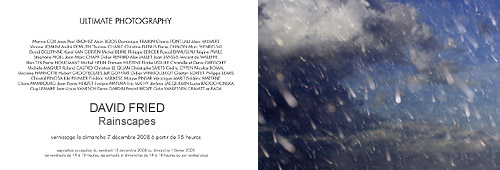
Monos Gallery, Rue Henri Blès 39, 4000 Liège Belgium.
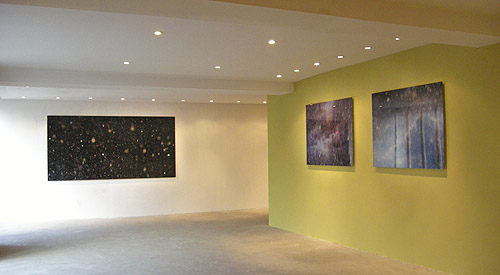
2007
EINLADUNG / INVITATION :
DAVID
FRIED
NEORDER
Opening
/
Ausstelleungseröffnung:
SONNTAG, 6. MAI, 2007 - 15:00 bis 20:00 Uhr
ART-FORUM
– Live Talk bei Noack
Thema: Zwichen Wissenschaft und Mythologie
Dienstag, den 15. Mai
Galerie
Noack
Moderation: Klaus Flemming
Künstler: David Fried
Kunsthistoriker: Jutta Saum
Kunstkritiker: Dr. Ingeborg Schnettler, Rheinische Post
Gast: Dr. Bärbel Lenz
Galeristen: Klaus Noack, Guido Nawroth
Dauer der Ausstellung: 06.05. bis 04.06.2007
For more information see:
<< home